Tuesday, March 22, 2011

HTC Thunderbolt hand-on

So you went ahead and got Verizon’s first 4G LTE phone, the HTC Thunderbolt, eh? The phone is great, but you want to do more, do you? Well, below is a tutorial for rooting the device and unlocking the bootloader. This is by no means for someone who doesn’t know what they are doing. If you think you have what it takes, read on!
You’ll need:
ADB set up correctly (some knowledge how to use it would help, too)
Patience (look through the tutorial before you begin. If using the command line is new to you, you may want to wait until a more elegant root method comes along.) Double check that you’ve typed the correct commands.
Know that this will void your warranty
This could potentially brick your phone. We take no responsibility if this happens. You’ve been warned.
Make sure your Thunderbolt is fully charged before proceeding.
1. Download the following files (mirrors are available below from the source link below)
  • RUU_Mecha_VERIZON_WWE_1.03.605.10_Radio_1.02.00.01 03_2r_NV_8k_1.37_9k_1.52_release_165253 (md5sum : aae974054fc3aed275ba3596480ccd5b): DOWNLOAD
  • Exploits package (md5sum : 3b359efd76aac456ba7fb0d6972de3af):  DOWNLOAD
  • Custom RUU mirrors (md5sum : aff07b8256628a175c40938d408fa16f): DOWNLOAD
2. Unzip the Exploits package, and push : psneuter, busybox, and misc.img to data/local
adb push psneuter /data/local/
adb push busybox /data/local/
adb push misc.img /data/local/
adb shell chmod 777 /data/local/psneuter
adb shell chmod 777 /data/local/busybox
3. “This step will gain temp root and flash the custom misc.img. Run:”
  • adb shell
You should then see a “$” in the command line, now run:
  • /data/local/psneuter
ADB will restart as root (#) – Now confirm the md5 of the misc.img
  • adb shell
If you see the “#”, run the following:
  • /data/local/busybox md5sum /data/local/misc.img
If the output is anything other than “c88dd947eb3b36eec90503a3525ae0de” , download the misc.img file again, and push it again.
If the md5 is correct, now you need to write the image
  • dd if=/data/local/misc.img of=/dev/block/mmcblk0p17
  • exit
4. Now it’s time to rename the custom RUU file (Third file you downloaded) to PG05IMG.zip
After the file has been renamed, put it on the root of your SDcard (inside no folders) and run:
  • adb reboot bootloader
Choose the bootloader option from the screen, and press power. This will flash the ROM. When it asks you to upgrade, choose yes. This can take a while, so don’t worry.
After it’s complete, reboot the device and delete the PG05IMG.zip file from your SDcard.
Now we’re going to set up the two-part exploit to get root and unlock the MMC:
Push wpthis, busybox, and psnueter:
adb push psneuter /data/local/
adb push busybox /data/local/
adb push wpthis /data/local/
adb shell chmod 777 /data/local/psneuter
adb shell chmod 777 /data/local/busybox
adb shell chmod 777 /data/local/wpthis
Now run the following:
adb shell
/data/local/psneuter
To unlock eMMC:
adb shell
/data/local/wpthis
exit
6. Potential phone-bricking step:
Now we’re going to push the eng bootloader. You’re messing with system partitions right now, so this can be dangerous if you do no complete the step correctly.
Run:
adb push hbooteng.nb0 /data/local/
adb shell
/data/local/busybox md5sum /data/local/hbooteng.nb0
The output number should be “6991368ee2deaf182048a3ed9d3c0fcb“. If it does not match exactly that, then stop, delete the file, and re-download it. It, too, is a part of the Exploit package. If it does match, carry on.
Run:
dd if=/data/local/hbooteng.nb0 of=/dev/block/mmcblk0p18
Run the following to ensure the file was written succesfully:
/data/local/busybox md5sum /dev/block/mmcblk0p18
If you don’t get “6991368ee2deaf182048a3ed9d3c0fcb” as the output code, try again. (If you’ve tried several times, seek help in the IRC chat – chat.andirc.net in channel #thunderbolt.) If you get the correct code, proceed.
Reboot the phone – place the custom RUU (PG05IMG.zip) onto the SD card again, and flash it.
Run:
adb reboot bootloader
“After it flashes, you will be running release firmware with S-OFF.”
7.
Push busybox, SU, and psneuter -Run:
adb push psneuter /data/local/
adb push busybox /data/local/
adb push su /data/local/
adb shell chmod 777 /data/local/psneuter
adb shell chmod 777 /data/local/busybox
Time to gain root access!
Run:
adb shell
/data/local/psneuter
Now we remount the /system and set up SU-
Run:
adb shell
mount -o remount,rw -t ext3 /dev/block/mmcblk0p25 /system
/data/local/busybox cp /data/local/su /system/xbin/su
chown 0:0 /system/xbin/su
chmod 6755 /system/xbin/su
8.
Reboot your phone
Go to the Android Market and install Superuser
Reboot your phone again
You should now have full root.
9.
Now all you have to do is install ROM Manager and flash the Thunderbolt recovery. You’re done!

Symbian's Last Gasp on T-Mobile

Nokia is planning to launch its Symbian-powered C7 on T-Mobile, in a bid to maintain some presence in the smartphone market while readying its next-generation of Windows handsets.

Top News

Sprint Integrates Google Voice for Multi-Phone Calling

AT&T Introduces Two High-End Smartphones

Nokia Races to Launch Windows Phone Before 2012

School Bus Driver Busted for Texting at Wheel

Facebook Buys Snaptu, to Make Mobile Apps

More News >
The Espoo, Finland-based handset maker, which won't ship a significant number of Windows phones until 2012, could debut the C7 -- called the "Astound" for T-Mobile -- as early as April, according to people familiar with the matter.
The Symbian-based handset would cost $80 on contract, and feature a 3.5-inch AMOLED touch screen, a 680-megahertz chip, 8.0-megapixel camera and a VGA webcam. Analysts, who describe the C7 as a consumer version of the flagship N8, said the Astound replaces the Nuron.
This will probably be among the last Symbian phones, though Nokia has promised to support the platform for several years to come.
Following its catastrophic failure to recognize demand for touch screen, app-centric smartphones, Nokia's share of the U.S. smartphone market shrunk to a sliver as Google and Apple dominated the sector. Thanks to stronger adoption overseas, Symbian was still the largest smartphone platform globally until the fourth quarter last year, when it was passed by Android, according to research firm Canalys.
Going forward, it is unlikely that any Symbian phone will have much of a following. Users have been abandoning the platform for the user-friendly app ecosystems offered by Apple and Google -- a shift that is likely to accelerate as the popularity of app-ready handsets increases. Potential buyers will also know that any Symbian device has a limited lifespan and that support for the platform is likely to disappear.
But the release of a Symbian phone may be a concession towards Nokia's current crop of developers, keeping them interested and committed enough to begin to develop apps for Windows Phone 7 smartphones later, according to analysts at Forrester Research. The phone also maintains a presence for Nokia in the market, even if the offering isn't entirely competitive. To disappear from the market, even for a short time, could endanger Nokia's presence with U.S. carriers even more.
Last year AT&T decided to cancel the release of the X7, a gaming-centric version of the N8, which would have been released earlier this year.

Use of app instead of mobile Safari makes browser speed test flawed?

Yesterday we reported on a test that tracked the speed of the browser on the Apple iPhone 4 against that of the Android flavored Nexus S. The test was conducted 45,000 times on 1,000 different sites and allegedly showed that the Android browser was 52% faster than the iOS 4 browser.

Many were surprised by the results, especially in light of JavaScript improvements recently made to mobile Safari. According to those who studied the contest, the reason why the JavaScript improvements seemed to have no effect during the test was that mobile Safari was not used in the competition. Instead of using the actual browser, the testing was done using Apple's own proprietary app, UIWebView, that bypassed the improvements made to the iOS browser. Apple had developed the UIWebView to allow web browser functions to be used within an app but the app does not include the improvements made to the actual browser itself.

So now it seems that there is a legitimate challenge to the results. Blaze can re-do the tests using the actual Safari browser, or someone with plenty of time on his hands can develop their own test for measuring which browser is faster. In the meantime, the record book that shows the Android browser 52% faster than mobile Safari will have to include an asterisk next to the results for now.

TELUS to release the Wi-Fi only Motorola XOOM

The Motorola XOOM was announced today and it looks like TELUS will be selling this Android 3.0 tablet. They stated in the press release that this will be available “as little as $599.99″. There is also no official release date yet but Future Shop stated this has an estimated release date of April 8th.
The specs of this tablet have it with a 10.1-inch display (resolution of 1280×800), 5 megapixel camera that records 720p HD videos, 2 megapixel front-facing camera, dual-core 1GHz processor, 10 hours of battery life, 1GB RAM, WiFi, and holds 32GB with a microSD card.
David Fuller, Chief Marketing Officer at TELUS said “We are thrilled to bring the first Android 3.0 powered tablet to Canadians. Almost by the month, Canadians are doing more through multiple ‘screens’ which tablets and smartphones provide. They’re a dashboard for our busy lives and on-the-go entertainment needs. TELUS is committed to delivering not only multiple screens, but the very best screens for the job. The MOTOROLA XOOM boasts best-in-class features and a rich mobile experience in one breathtaking package. This was worth waiting for.”
Sprint today integrated Google Voice with its smartphones, allowing customers to answer calls from home, the office, or on a PC, as well as provide a new service that AT&T and Verizon lack.

Top News

AT&T Introduces Two High-End Smartphones

Nokia Races to Launch Windows Phone Before 2012

School Bus Driver Busted for Texting at Wheel

Symbian's Last Gasp on T-Mobile

Facebook Buys Snaptu, to Make Mobile Apps

More News >
The Overland Park, Kan.-based carrier said its customers can use their existing phone number as their Google Voice number, so calls to that Sprint number can also be answered at the office, home, computer or even Gmail.
Or, Google Voice users can make calls and send texts from a Sprint phone, by swapping numbers. Calls overseas are also routed through Google's Web-based system, for cheaper rates.
Basically, it's a smarter way to manage voice communications; especially for those with multiple phones or phone numbers.
"We have made Google Voice simple to use with a Sprint phone," said Dave Girouard, president of Google's enterprise group.
Sprint is essentially giving up control of its phone number, a bold move no other carrier has done, to gain an edge over rivals AT&T and Verizon, who are selling the popular iPhone and iPad. In addition, Sprint aims to save money by not having to sustain its own voicemail platform.
Google Voice allows users to make free calls and texts anywhere in the U.S. and Canada. It also lets multiple phones ring at once, even if those phones belong to one number. Even more, Google Voice is known for its accurate voicemail transcription, which can be emailed or texted to phones.
The service includes call recording, blocking, and personalized greetings for selected callers.
PDATED: AT&T presentation slides, Deutsche Telekom's stake.

Now this makes much more sense - unlike the rumor that Sprint will be buying T-Mobile, it turned out that actually the carrier that uses the same GSM technology - AT&T - is buying Big Magenta, for $39 billion in cash and stocks.

Deutsche Telekom will receive $25 billion in cash, and $14 billion in stocks, some of which it will use to pay off debt and for share buybacks, plus it will get 8% stake in AT&T because of the stock portion. The German telecom acquired T-Mobile (previously VoiceStream), for $24 billion in 2001 - not as bad of a deal as some thought, it turns out.

It was the logical thing to happen ever since Deutsche Telekom put T-Mobile on the market. The buyout will add 34 million subscribers to AT&T's count, and create the largest US carrier with 130 million customers in a year's time, when the deal is expected to clear the red tape. If it gets the antitrust authorities approval, of course. AT&T is holding a press conference tomorrow to talk us into it, so we will tune it at 8am Eastern for the gulp of Kool-Aid, meant for the FCC, since all companies' boards involved have already approved it. If for some reason the deal doesn't go through, AT&T is on the hook to pay T-Mobile child support to the tune of $3 billion for the break-up, according to the agreement.

Well, at least now the 4G LTE plans will get a huge boost, when the 700MHz spectrum of AT&T, and T-Mo's AWS frequencies combine, and that's precisely what AT&T means to do, according to the press release. Combining both carriers' airwaves, it said, will allow the new GSM behemoth to reach 95% (294 million) of Americans with its upcoming LTE network - 46.5 million more than if AT&T was doing it alone.

From the presser: "AT&T and T-Mobile USA customers will see service improvements - including improved voice quality - as a result of additional spectrum, increased cell tower density and broader network infrastructure. At closing, AT&T will immediately gain cell sites equivalent to what would have taken on average five years to build without the transaction, and double that in some markets.  The combination will increase AT&T’s network density by approximately 30 percent in some of its most populated areas, while avoiding the need to construct additional cell towers."

Here are some slides explaining the synergies, plus AT&T cherry-picking states to show us the brave new world we could live in as soon as next year:


On the flip side, this probably will end T-Mo's tradition of being the bargain carrier. It might also take some phones off the portfolio of the resulting telco, due to overlapping, but, in that respect, manufacturers will do wonders with their newest handsets just to get the attention of America's biggest carrier, so it might all turn out for the better.

Not to mention the awards T-Mo has gotten on a more than few occasions for excellent customer service and overall satisfaction. Of course, everything is puppies and flowers, according to AT&T, which has inserted some twisted logic into a slide sure meant to appease Uncle Sam's antitrust regulators, but not really backed up by anything of substance, except for the timeline:

Verizon and Sprint are probably less than thrilled by this development. What do you think, will that surprise move stifle competition in the US, or will we benefit from the apparent synergies between the two GSM carriers?

Monday, March 21, 2011

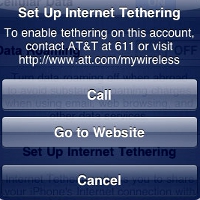
AT&T fed up with you milking its data network, sends warning letters to covert tetherers

AT&T has started sending out warning messages to owners of jailbroken iPhones, which use the MyWi app for unauthorized sharing of their phones's mobile data connection. By unauthorized we mean you don't pay the $20 a month AT&T asks for tethering, and you don't sleep in peace with yourself and the world. High-usage subscribers are reportedly also receiving such messages, and we wouldn't be surprised if a bunch of folks with rooted Android handsets are in the crosshairs for off-the-grid tethering, too. Here is an excerpt from AT&T's letter:

" Dear [Name of Account Holder],

We’ve noticed your service plan may need updating.

Many AT&T customers use their smartphones as a broadband connection for other devices, like laptops, netbooks or other smartphones– a practice commonly known as tethering. Tethering can be an efficient way for our customers to enjoy the benefits of AT&T’s mobile broadband network and use more than one device to stay in touch with important people and information. To take advantage of this feature, we require that in addition to a data plan, you also have a tethering plan.

Our records show that you use this capability, but are not subscribed to our tethering plan.
If you would like to continue tethering, please log into your account online at www.wireless.att.com, or call us at 1-888-860-6789 Monday – Friday, 7 a.m. – 9 p.m. CST or Saturday, 8 a.m. – 7 p.m. CST, by March 27, 2011 to sign up for DataPro 4GB for Smartphone Tethering...

If we don’t hear from you, we’ll plan to automatically enroll you into DataPro 4GB after March 27, 2011. The new plan – whether you sign up on your own or we automatically enroll you – will replace your current smartphone data plan, including if you are on an unlimited data plan.

If you discontinue tethering, no changes to your current plan will be required."

So those of you with such letters have basically until next Sunday to sign up for the $45 a month DataPro 4GB plan and tether all they want, or be enrolled in it automatically, unless you stop the illegal tethering and/or excessive data usage.

Quite the move on AT&T's part, and if you wonder how they know who does what, it's probably a combination of abnormal data usage and Deep Packet Inspection (DPI) the carrier is using to determine where to send the warnings to. You can get around DPI by using a VPN, but the legality of this is debatable for individual users.

Have you received such a letter from AT&T, and what do you think about the whole "to tether or no to tether" conundrum the carrier is creating?